


For many homeowners, a damp, “earthy” aroma in the lower levels of the house is simply accepted as a part of owning a home with a basement. You might try to mask it with scented candles, plug-in air fresheners, or a standard portable dehumidifier, only to find the scent returns the moment the fragrance fades. However, that persistent musty basement smell is far more than a cosmetic nuisance or a minor unpleasantness.
In the world of building science, a musty odor is a biological red flag. It is a clear signal that your home’s ecosystem is out of balance, and more importantly, that the air your family breathes may be contaminated. Understanding why your basement smells and how that air travels through your home is the first step toward reclaiming a healthy living environment.
The Science of the “Musty” Scent: MVOCs and Mold
 The characteristic smell of a damp basement is actually caused by Microbial Volatile Organic Compounds, or MVOCs. These are strong-smelling gas products released directly by mold, mildew, and bacteria as they grow and digest organic materials like wood, drywall, and dust. When you catch that scent, you are literally breathing in the chemical byproducts of an active fungal colony.
Exposure to these compounds and the microscopic spores that accompany them can lead to a variety of health issues. For family members with asthma or allergies, the basement can become a primary trigger for respiratory distress. Even healthy individuals may experience “Sick Building Syndrome” symptoms, including persistent headaches, itchy eyes, and unexplained fatigue, simply because the basement is serving as a reservoir for poor air quality.
Understanding the Stack Effect: How Basement Air Travels Upward
You might think that if you stay out of the basement, the bad air won’t affect you. Unfortunately, physics dictates otherwise. Homes operate under a principle known as the “Stack Effect.” This phenomenon occurs because warm air is less dense and rises toward the upper levels and attic of your home. As this warm air escapes through the top, it creates a vacuum effect in the lower levels.
This vacuum pulls air from the basement and crawlspace upward into your main living areas. Building scientists estimate that as much as 50% of the air you breathe on the first floor of your home originated in your basement or crawlspace. If that lower-level air is filled with MVOCs, moisture, and soil gases, it is being distributed throughout your bedrooms and kitchen 24 hours a day.
Why Standard Dehumidifiers Fail to Stop the Odor
The most common reaction to a damp basement is to purchase a portable dehumidifier. While these units can pull some moisture out of the air, they rarely solve the underlying problem. A standard dehumidifier is a “re-circulating” device; it takes the same stagnant, contaminated basement air, dries it slightly, and blows it back into the room.
Furthermore, dehumidifiers are notorious for their high energy consumption and maintenance requirements. Many homeowners grow tired of emptying water buckets or find that the unit simply cannot keep up with the sheer volume of moisture seeping through the concrete walls. Because they do not exchange the air, the MVOCs and toxins remain trapped in the room, maintaining that “heavy” feeling and lingering scent.
The Permanent Solution: Active Ventilation and Air Exchange
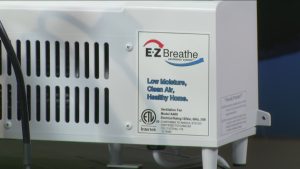
 To truly eliminate the health risks associated with a musty basement, you must move beyond re-circulation and move toward active air exchange. The EZ Breathe Ventilation System works by addressing the root cause of the problem: stagnant, heavy, and contaminated air. Rather than just drying the air, the system exhausts the dampest, most contaminated air from the lowest point of the home and expels it outside.
This process creates a much-needed air exchange that reverses the negative effects of the stack effect. By removing the “fuel” for mold—excessive humidity and stagnant air—the system creates an environment where MVOCs cannot thrive. This results in a basement that not only smells fresh but is structurally drier and healthier for everyone in the home.
Immediate Benefits of a Healthier Basement Environment
When you address basement air quality, the benefits ripple through the entire house. Homeowners frequently report a significant reduction in allergy symptoms and a noticeable “lightness” in the air on every floor. Beyond health, active ventilation protects your home’s structural integrity by preventing the wood rot and metal corrosion that thrive in high-humidity environments.
An EZ Breathe system operates for a fraction of the cost of a dehumidifier, usually under $4 a month, providing a maintenance-free solution that allows you to stop worrying about buckets and start focusing on your family’s wellness. A fresh-smelling basement is the sign of a healthy home.
Frequently Asked Questions
Does a musty smell always mean there is mold?
Not necessarily visible mold, but the smell is often caused by Microbial Volatile Organic Compounds (MVO
Cs) released by mold or mildew growing in damp, dark areas or behind walls. If you smell it, the biological process is happening somewhere.
Can I just use a candle or spray to fix the smell?
No, those products only mask the odor with chemicals. To fix the smell, you must address the source by removing the stagnant, damp air and replacing it with fresh, filtered air through a proper ventilation system.
How does EZ Breathe remove basement odors?
The EZ Breathe unit is installed at the lowest point of the home where the heaviest, dampest air settles. It mechanically exhausts this contaminated air to the outside, breaking the cycle of stagnation and preventing the smell from traveling upstairs.
Ready to reclaim your home’s air quality? Stop breathing contaminated air and protect your family from the hidden risks of a damp basement. Contact EZ Breathe today for a custom basement air quality assessment and see the difference that building science can make.