Washington, D.C. | EZ Breathe Ventilation Systems

EZ Breathe Ventilation Systems Improves The Health Of Your Home | Washington, D.C.

The air quality in your home can impact your health. It is important to invest in a ventilation system that can filter allergins in order to have the healthiest possible indoor air quality. Let’s face it, our homes are full of pollutants. They are in the electronics we buy, the plastic packaging, the floors, the carpets, the sofa, the fabric of our curtains and practically anything that is produced commercially. There are also various pollutants around the home that aren’t in obvious places e.g. basement mold.

If you want to improve indoor air quality, you can start by answering the questions below:

  1. Do you have moisture problems in your basement?

Not many people realize that the state of their basement affects the quality of the air in their homes. This is the result of stack effect, which results in the rising of air from the basement into the rest of the home.

If you’re experiencing moisture problems in your basement, you’re also likely to have a mold or mildew infestation. You are also likely to be affected by microbial growth. Mold spores and bacteria can spread to the rest of the home in the air that rises from the basement into the rest of the home.

Washington, D.C. | EZ Breathe Ventilation Systems

  1. Do you have rodents or insects in your home?

Yes, rodents and insects affect indoor air quality. Their fur and particles from their feces can easily spread in the air that circulates in your home. These particles are allergens that can cause or exacerbate allergic reactions. You may experience worsening of asthma symptoms or the development of various other respiratory conditions as a result of the presence of these allergens.

  1. Do members of your family experience frequent bouts of illnesses or allergies?

Many people write this off as a problem with immunity. However, it is most likely the presence of allergens and disease-causing organisms in the air you breathe in your home.

Addressing issues of air quality

It isn’t enough to invest in HEPA filters that will get rid of small particles. You need to ensure that you have fresh air circulating in your home. You can achieve this by investing in a ventilation system that circulates fresh air from the outdoors into your home. These systems ensure that you are not breathing in the same stale air. They get rid of allergens and gaseous toxins to ensure better air quality in your home.

Contact EZ Breathe Systems today!  (866) 822-7328
Minneapolis, MN | Basement Ventilation | EZ Breathe indoor air qualitiy professionals can guide you with choosing an EZ Breathe System that will improve your homes indoor air quality

Indoor Air Quality – 3 Reasons to Worry About Dampness in the Home | Minneapolis, MN

Have you noticed a leak in your home? Is your home damp? It doesn’t matter whether the leak is in your basement or in your bathroom; the fact is that it is likely to cause your home to become damp. It doesn’t matter how small the leak is. Ensure that you have it attended to as soon as your notice it.
Why you should be worried about moisture
It can be tempting to ignore that little leak in your home. However, not repairing the problem won’t make it go away. In fact, it is only likely to become worse. If you’re concerned about indoor air quality, you ought to also be concerned about those leaking pipes.
Several scientific studies have linked high levels of moisture in homes with respiratory problems. This is a result of the following agents that occur in homes with higher levels of moisture and humidity.

ew York, NY | Basement Ventilation | EZ Breathe indoor air qualitiy professionals can guide you with choosing an EZ Breathe System that will improve your homes indoor air quality1. Bacteria
Bacteria loves moisture. Moisture provides the perfect environment in which they can breed and thrive. It doesn’t matter how much antibacterial products you use. They cannot compensate for the effects of a damp house. The bacterial colonies will re-establish themselves. It is therefore vital to get rid of the moisture and maintain low levels of humidity.
2. Mold
This is one of the most common concerns linked with damp spaces. Mold thrives in damp spaces. They cause a musty smell which can be used to detect their presence.
Exposure to molds can result in various health conditions. Top on this list are respiratory conditions.
Investing in mold remediation will help to get rid of an infestation. However, if you want to prevent the infestation from recurring, you should ensure that you deal with the moisture problem and maintain live levels of humidity.
3. Dust mites
Dust mites are a common allergen. Those who are allergic to them develop symptoms such as sneezing, stuffy noses, itchy eyes as well as respiratory problems. While dust mites are ever present, high levels of humidity will result in higher population of these microscopic critters.
Dust mite growth can be stopped if you keep your home’s humidity levels below 50 percent. This will mean addressing any moisture problems and investing in a system that will keep the moisture levels down.
Don’t wait for your symptoms to become serious in order to take action. Ensure that your home’s moisture levels are low for good indoor air quality.

Contact EZ Breathe today! (866) 822-7328

Columbus, OH | EZ Breathe

Tips for Keeping a Healthy Home | Minneapolis, MN

 Tips for Keeping a Healthy Home

The U.S. Department of Housing and Urban Development and the Office of Healthy Homes and Lead Hazard Control has put together seven tips for keeping a healthy home:

1. Keep it Dry

Prevent water from entering your home through leaks in roofing systems, rain water from entering the home due to poor drainage, and check your interior plumbing for any leaking.

2. Keep it Clean

Control the source of dust and contaminants, creating smooth and cleanable surfaces, reducing clutter, and using effective wet-cleaning methods.

3. Keep it Safe

Store poisons out of the reach of children and properly label. Secure loose rugs and keep children’s play areas free from hard or sharp surfaces. Install smoke and carbon monoxide detectors and keep fire extinguishers on hand.

4. Keep it Well-Ventilated

Ventilate bathrooms and kitchens and use whole house ventilation for supplying fresh air to reduce the concentration of contaminants in the home.

5. Keep it Pest-free

All pests look for food, water and shelter. Seal cracks and openings throughout the home; store food in pest-resistant containers. If needed, use sticky-traps and baits in closed containers, along with least toxic pesticides such as boric acid powder.

Seven Tips for Keeping a Healthy Home- EZ Breathe


6. Keep it Contaminant-free

Reduce lead-related hazards in pre-1978 homes by fixing deteriorated paint, and keeping floors and window areas clean using a wet-cleaning approach. Test your home for radon, a naturally occurring dangerous gas that enters homes through soil, crawlspaces, and foundation cracks. Install a radon removal system if levels above the EPA action-level are detected.

7. Keep it Well-Maintained

Inspect, clean and repair your home routinely. Take care of minor repairs and problems before they become large repairs and problems.

You can download the PDF version of these tips here.

For more information on what the EZ Breathe Ventilation System does click here.

Indoor Air Quality – 3 of the Most Common Household Air Pollutants | Philidelphia, PA

Indoor Air Quality – 3 of the Most Common Household Air Pollutants

According to EPA, you may be surprised to know that indoor air is much more polluted than the air outside. There are a wide variety of household pollutants that are responsible for this. The following are the most common pollutants that are compromising your indoor air quality and putting the health of your household at risk.

1: Mold

This is a fungus that produces spores that become airborne when the fungus is disturbed. These spores land on various surfaces around the home to establish new fungal colonies. Mold infestations are often the result of high levels of humidity.

Mold spores are difficult to control once a mold infestation has established itself in your home. They can trigger allergic reactions and worsen asthma symptoms. You may experience sneezing, red eyes and skin rash. We Can Help! Contact Us! (866) 822-7328


The best way to deal with mold is by getting rid of it. This is possible through mold remediation. You can prevent the establishment of an infestation by ensuring that humidity levels in the home are controlled and the home is ventilated. This is possible with a whole-home ventilation system.

2: Volatile organic compounds (VOCs)

These compounds are chemicals that evaporate into the air. They are present in paint thinners, glues, adhesives, finishes, upholstery and many other items in the home. VOCs can cause serious health problems including damage to the central nervous system, liver and kidneys in the long term.

It is difficult to control the levels of VOCs in the home because they are present in many of the products we bring into our homes. You can opt to limit bringing such products into the home and instead rely on natural or organic products. You should also ensure that the home is well ventilated to keep concentrations of VOCs at a minimum. The EZ-Breathe family of home systems can provide the relief, and best indoor air quality possible.

3: Carbon monoxide

Carbon monoxide is one of the biggest pollutants. It is often released as a result of common activities in the home including cooking and heating the home. Carbon monoxide is odorless and colorless. It can be deadly in high concentrations.

You can reduce the levels of carbon monoxide in the home by venting stoves, heaters and dryers. You should also ensure that the entire home is well ventilated to reduce the concentration of carbon monoxide in the home.

Investing in a whole home ventilation system can help to reduce exposure to the above mentioned air pollutants and improve indoor air quality a great deal.


Primary Sources of Indoor Air Toxins and Allergens – Cleveland, OH

Pity the poor bathroom fan.

Infrequently the concern of most homeowners. Seldom the recipient of adequate investment by builders. In most dwellings, it’s not uncommon for the vents to be furred with dust. Yet it can dramatically improve the comfort of a home or apartment’s atmosphere, and in some cases even help the occupants live longer and better. In fact, some experts on the subject leave theirs running constantly in certain seasons.

Click here for more related information on how EZ Breathe removes allergen triggers in your home.

This whitepaper will address several sources of indoor air contamination, some of which are well known. Others will be less so. For example, few people realize that one of the most common causes comes right from their stovetops: Spaghetti. Learn more by clicking on the link below.

Download the whitepaper today.

Flu Season & Indoor Air Quality – Chicago, IL

It’s that time of the year again. It’s cold outside and the flu is spreading like a wild fire. You’ve even had to take some days off work to recover from the flu indoors. However, you may be doing yourself more harm than good.

It’s in the air we breathe

Are you truly safe indoors? Can staying indoors help you avoid the flu? Can it help reduce symptoms or help you feel better?

The truth is that once the viruses that cause colds and the flu have made it into the home, the indoor air quality of the home is compromised. This is true even if you have a highly efficient HVAC system.

HVAC systems only recirculates air within the home. The filtration of air in these systems results in the removal of large particles. Microscopic organisms such as viruses and mold spores often make it through these filters.

Another problem with staying indoors is the fact that modern homes are built for greater efficiency. The air in the home is not vented to the outside. The air outdoors cannot enter the home. The air conditioning systems simply recirculate the air within the home. This means that we are inhaling stale air that is full of viruses.

Lastly, viruses aren’t only in the air we breathe. They are also on surfaces around the home. They can easily spread from one person to another when transferred from the contaminated surface.

A solution

The best way to deal with the flu this season is to ensure better indoor air quality. There’s no better way to do this than to let air from the outside into the home and let the stale air out of the home.

‘But it’s cold outside,’ you say. You don’t have to open the windows to let the stale air out and fresh air in. You can invest in a ventilation system that cycles the air in and out of your home. This type of system will ensure that your home continues to be energy efficient while maintaining a high level of indoor air quality.

These systems work by pumping stale air out of the home and bringing fresh air from the outside into the home. There are no filters to clean because filtration is not required. The cool air is heated as it is cycled into the home, thus ensuring that you remain comfortable.


Why Winter Makes Indoor Air Quality Worse

Why Winter Makes Indoor Air Quality Worse

Homes are built to be energy- (and therefore cost-) efficient by holding heat in during the winter time and keeping heat out during the summer. Winter weather prompts homeowners to tightly seal any cracks in insulation that could allow cold drafts into the home. This, in turn, also seals off the home from any fresh air and raises the concentrations of allergens, pollutants and chemical concentrations in the home.

Add Stack Effect…It gets Worse!

indoor air qualityThe same force that causes hot air balloons to rise in to the sky is present in all of our homes. This “stack effect” draws air up from the lowest levels through floors, doors, windows, and up from the basement and/or crawlspace commonly called “chimney effect”. This stack effect or chimney effect is very powerful during the winter heating season actively introducing basement/crawlspace air up into the living environment contaminating the quality of indoor air.
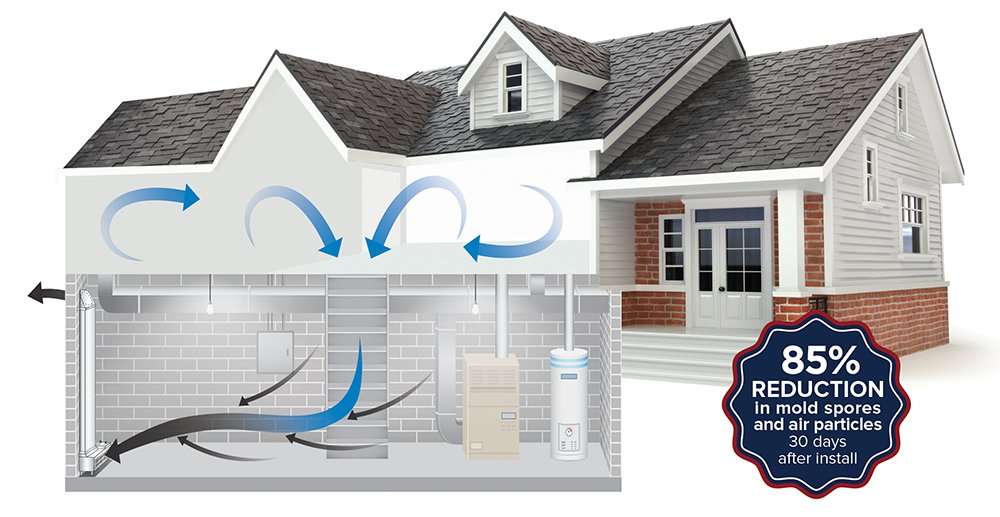
40% of the air we breathe in the living spaces was once basement/crawlspace air!

Effects of Poor Indoor Air Quality

Immediate effects of poor indoor air quality can show up after just a single exposure and include headaches, dizziness, fatigue, and itchy eyes, nose, and throat. Asthma and chemical sensitivities can also be aggravated by exposure to indoor pollution. Allergic responses to pollutants in the air can last for months on end as the air quality continues to worsen. Chronic sensitivities may also build up after repeated exposures.

Although it remains uncertain what levels or periods of exposure are necessary to bring on serious health effects from indoor air pollution, long-term effects of indoor air pollution include respiratory disease, heart disease, and cancer.

Improving Indoor Air Quality

The EPA recognizes two basic strategies to improve indoor air quality: source control and ventilation improvements.

Improving indoor air quality through source control involves removing the sources of pollution. Gas emissions, like those from a poorly maintained stove, for instance, can be adjusted in order to lower their emissions; asbestos can be sealed or enclosed. Often, source control is a more cost-conscious way to remedy poor air quality, however source control is not always possible or practical.

Increased ventilation is an easy and effective way to control poor indoor air by bringing fresh indoor air into circulation. Especially because most heating systems do not bring fresh air into the home. Whole home ventilation systems not only create a path of escape for the myriad of pollutants trapped inside our homes, but also make room for better air to be introduced. Solution by dilution. Increase the amount of fresh air entering the building envelope is an effective way to improve the quality of indoor air

You can easily check to see if your home might have ventilation problems. Condensation on walls or windows, stuffy air, moldy areas, or dirty heating or cooling equipment are all indicators. Odors (which are most notable upon entering the home from outdoors) are also an indication of poor ventilation.

When performing many home improvement or hobbies, it’s especially important to be aware of the need for proper ventilation. Without ventilation, pollutants such those emitted during painting, welding, sanding, or even cooking, can add toxic elements into your home environment.

To learn more about the benefits of ventilation click here: https://ezbreathe.com/about/why-ez-breathe/

April is National Asthma & Allergy Awareness Month

Asthma & Allergy Awareness Month

E●Z Breathe Offers a Breath of Fresh Air for Asthma & Allergy Awareness Month

Home Ventilation System Provides Relief from Environmental Irritants

See how EZ Breathe can help provide clean air for those with asthma.

Asthma and allergies are at epidemic proportions this spring. Asthma, a serious life-threatening respiratory disease, affects over 20 million individuals while allergies affect as many as 40 million Americans. According to the Asthma and Allergy Foundation of America (AAFA), the number of Americans with these two chronic conditions has at least doubled in the last twenty years. Currently, there are around 60 million people who suffer from either allergies or asthma and this number is on the rise. May is known as the peak time for seasonal allergies with pollen counts skyrocketing and sufferers seeking relief. Asthma and Allergy Awareness Month was put into effect to create awareness about these conditions and educate the public about ways minimize exposure. Understanding these health risks, the E●Z Home Ventilation System, (www.ezbreathe.com) seeks to help families improve the quality of air in the homes during the month of May.The development of asthma and allergies can be caused by several factors including genetics, lifestyle, and environmental factors. Although there is no cure at this time, asthma and allergies can be controlled through medical treatment as well as management of environmental factors. Awareness and prevention are the best defense against asthma and allergies. It is important for people to become aware of the triggers that can lead to allergy and asthma attacks and to minimize exposure to them. The most common allergy triggers include pollen, dust mites, mildew and mold, pet dander, smoke, cleaning products, and fragrances. EZ Breathe combats all of these issues by exhausting harmful contaminants in the air and replacing it with fresh ventilated air from outside.

Studies have indicated that home intervention in the form of a ventilation system is an effective, preventative approach to asthma and allergy symptoms. The E●Z Breathe Home Ventilation System improves quality of air within the home significantly, making it a safer, healthier place for the entire family. EZ Breathe is designed to ridthe home of harmful moisture and humidity, not re-circulate polluted air. EZ Breathe ventilates by drawing moist, stale, contaminated air out of the home, replenishes by replacing moist air with fresh dry air and regulates airflow to reach and maintain a desired level of humidity.

In addition to the unpleasant effects of asthma and allergies, the costs involved are significant. According to a study published in the Journal of Allergy and Clinical Immunology, the annual cost for asthma treatment is estimated at nearly $5,000 per person. The E●Z Breathe Home Ventilation System offers families the option of making a onetime investment towards their family’s health.

“It is very important for people to become aware of what pollutants are in the air that they breathe every day since these contaminants can trigger allergic reactions and/or asthma attacks” states Erika Lacroix, President of E●Z Breathe. “EZ Breathe offers a simple solution to improve indoor air quality and reduce the risk of illness related to indoor air pollution.”


http://www.healthstatus.com/health_blog/2009/05/05/asthma-and-allergy-awareness-month/

USA today, April 12, 2010

http://www.webmd.com/asthma/features/lowering-costs-asthma-treatment