
If you own a home with a basement or crawlspace, you are likely no stranger to the battle against humidity. Excess moisture in the lower levels of a home is the root cause of musty odors, mold growth, and structural wood rot. For decades, the go-to solution for homeowners has been the portable, plug-in dehumidifier. However, as building science has evolved, a more effective and efficient alternative has emerged: the EZ Breathe ventilation system. When choosing between an EZ Breathe vs. a dehumidifier, it is essential to understand that while both aim to control moisture, they use fundamentally different methods to achieve that goal. One merely treats a symptom, while the other addresses the source of the problem.
Recycled Air vs. Fresh Air Exchange
A traditional dehumidifier is a closed-loop system. It pulls in the damp, stagnant air already present in your basement, passes it over refrigerated coils to condense the moisture into a bucket or drain, and then blows the same air—now slightly warmer—back into the room. It does not address the quality of the air; it only addresses the liquid content. This means that while the air might feel drier, it still contains the same concentration of mold spores, radon gas, and volatile organic compounds (VOCs) that were there before.
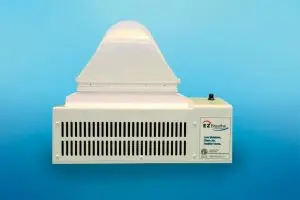
In contrast, the EZ Breathe system is an open-loop, mechanical exhaust system. Instead of recycling old air, it identifies the coolest, dampest, and heaviest air at the lowest point of your home and expels it completely out of the house. As this stale air is exhausted, it is replaced by a fresh air exchange from the upper levels of the home. This process doesn’t just dry the air; it purifies the entire home’s environment by constantly cycling out pollutants and bringing in fresh, filtered air from the living spaces above.
The Maintenance Battle: No More Emptying Buckets
One of the most significant drawbacks of a standard dehumidifier is the labor-intensive maintenance it requires. Most portable units have small water reservoirs that must be emptied manually once or twice a day. If you forget to empty the bucket, the unit shuts off, allowing humidity levels to spike instantly. Even units equipped with a hose and floor drain require regular filter cleaning and coil maintenance to prevent the machine itself from becoming a haven for mold and bacteria.
The EZ Breathe system is designed to be “set it and forget it.” Because it exhausts moisture as a vapor rather than collecting it as a liquid, there are no buckets to empty and no standing water to worry about. There are also no expensive filters to replace. Once the system is installed, it operates automatically based on the humidistat settings you choose, providing a truly maintenance-free solution for busy homeowners.
Operational Costs: A $300 Yearly Savings Breakdown
When comparing the long-term value of an EZ Breathe vs. a dehumidifier, energy efficiency is where the EZ Breathe truly shines. Traditional dehumidifiers are notorious energy hogs. Because they rely on a compressor and cooling coils, they can easily add $30 to $50 per month to your electric bill during the humid summer months. Over the course of a year, you could be spending over $400 just to power a single unit.
Average Energy Consumption Comparison
The EZ Breathe unit operates on the same amount of electricity as a 40-watt lightbulb. Because it uses a high-efficiency fan rather than a heavy compressor, the average operating cost is only $2 to $4 per month. This means the system often pays for itself in energy savings alone within just a few years. When you factor in the fact that one EZ Breathe unit has the moisture-removal capacity of approximately seven large portable dehumidifiers, the cost-benefit analysis becomes overwhelmingly clear.
Coverage Area: One Unit vs. Multiple Dehumidifiers
Most portable dehumidifiers are designed to treat a single room or a small area of up to 500 or 800 square feet. If you have a large basement or a complex crawlspace layout, you may find yourself needing three or four separate units to keep the entire space dry. This multiplies your energy costs and your maintenance chores.
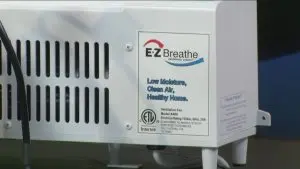
A single EZ Breathe unit is powerful enough to provide 6 to 10 air exchanges per day for an area of up to 7,000 square feet. By creating a powerful pressure differential, it pulls air from every corner of the basement and even from the upper floors, ensuring that no “dead air” pockets remain. This whole-home approach is something a standard dehumidifier simply cannot replicate.
FAQ
Q: Does EZ Breathe remove as much water as a dehumidifier? A: Yes, but it does so more efficiently. Instead of wringing water out of stagnant air, EZ Breathe removes the moisture-laden air itself. This prevents the “damp feeling” from ever occurring and keeps the structural wood of your home dry-to-the-touch.
Q: Is the EZ Breathe system loud? A: No. The EZ Breathe is engineered for whisper-quiet operation. It is significantly quieter than a traditional dehumidifier’s compressor and sounds similar to a high-end bathroom exhaust fan or a low-profile window fan.
Q: Does EZ Breathe help with radon levels? A: While EZ Breathe is not a primary radon mitigation system, its high-volume air exchange properties significantly reduce the concentration of soil gases, including radon, by constantly exhausting them out of the home.