

If you have ever noticed that a musty smell from your basement seems to linger in your second-floor bedroom, you aren’t imagining things. You are experiencing a physical phenomenon known as the “Stack Effect.” For homeowners, the Stack Effect is one of the most significant factors influencing indoor air quality, energy efficiency, and overall health. Understanding the science behind how your home breathes is the first step toward creating a cleaner, drier, and safer living environment for your family.
Thermal Buoyancy: The Physics of Your Home’s Airflow

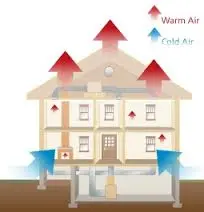
At its simplest level, the Stack Effect is driven by thermal buoyancy—the principle that warm air is less dense than cool air and therefore rises. During the colder months, the air inside your home is heated, causing it to move upward toward the highest points of the structure. As this warm air escapes through attic vents, recessed lighting, and gaps in your roofline, it creates a vacuum effect in the lower levels of the home.
To equalize the pressure, your home “inhales” replacement air from the lowest points—typically the basement or crawlspace. This creates a vertical current of air that moves from the soil, through the foundation, and up into your living spaces. Essentially, your house acts like a giant chimney, constantly pulling air from the bottom and exhausting it out the top. This cycle is what building scientists refer to as a “convective loop.”
Why Your Living Room Smells Like Your Basement
Many homeowners believe that the floors and walls separating their basement from the main floor are airtight barriers. In reality, your home is full of “air highways” that facilitate the Stack Effect. These pathways allow basement air to bypass traditional doors and insulation, delivering odors and contaminants directly into your primary living areas.
The Path of Least Resistance: Chases, Pipes, and Wiring
Air is an opportunist. It travels through plumbing stacks, electrical wire penetrations, ductwork gaps, and “chase” spaces behind your drywall. Even a tiny gap around a pipe under your kitchen sink can act as a portal for basement air to enter your living room. Because the Stack Effect creates a constant pressure differential, these air currents are relentless, moving hundreds of cubic feet of air every hour.
The Health Impact of “Bottom-Up” Air Circulation
The danger of the Stack Effect isn’t just the smell; it’s what that air carries with it. Because the air is being pulled from the basement or crawlspace—areas often high in humidity and low in ventilation—it acts as a delivery system for several “unseen irritants.”
Mold Spores: Basements are notorious for dampness. When mold grows on organic materials like joists or drywall, the Stack Effect carries those spores upward into bedrooms, where they can be inhaled throughout the night.
Radon Gas: Radon is a naturally occurring, radioactive gas that seeps through foundation cracks. Since it is heavier than air, it settles in basements, but the vacuum created by the Stack Effect can pull it into the upper levels of the home.
Soil Gases and VOCs: Chemical odors from stored paints, cleaning supplies, or damp soil gases are frequently transported via this convective loop, contributing to “Sick Building Syndrome.”
Reversing the Flow: How Mechanical Exhaust Creates Balance
To stop the Stack Effect, you must interrupt the pressure cycle. Traditional air purifiers or portable dehumidifiers simply recycle the existing air within a room; they do nothing to address the structural pressure differential. This is where a mechanical exhaust system like EZ Breathe becomes essential.
By installing a dedicated exhaust point at the lowest level of the home, you create a controlled “controlled exit” for stale air. This system essentially fights the Stack Effect by pulling the heavy, contaminated air out of the basement before it has a chance to rise. This creates a balanced environment where fresh, drier air from the upper floors is pulled down, reversing the chimney effect and ensuring that the air you breathe in your bedroom is not the air that was just sitting in your crawlspace.
FAQ
Q: Why is my allergies worse at night? A: The Stack Effect often intensifies at night as the outside temperature drops. This increases the temperature differential between the inside and outside of your home, causing the “chimney effect” to pull more basement allergens and mold spores into your sleeping areas.
Q: Does opening windows stop the Stack Effect? A: No. In many cases, opening upstairs windows can actually worsen the problem. By providing an easier exit point for warm air at the top of the house, you increase the vacuum pressure at the bottom, causing the home to pull even more air in through the basement or crawlspace.
Q: How do I measure the air quality in my basement? A: While you can use a hygrometer to check for humidity levels (anything over 50% is a red flag), the best indicator is often your nose. A “musty” smell is actually the scent of mVOCs—microbial volatile organic compounds—which are the gasses released by mold and bacteria. If you smell it in your basement, the Stack Effect is almost certainly carrying it into your bedroom.