

Have you ever noticed that a musty smell in the basement eventually finds its way into your upstairs master bedroom? Or perhaps you’ve wondered why your second-floor rooms feel incredibly stuffy in the summer, while the basement remains chilly and damp. This isn’t a coincidence or a quirk of your HVAC system; it is a fundamental principle of building science known as the “stack effect.” Understanding this phenomenon is the first step toward reclaiming the air quality and health of your entire home.
The Physics of Air: Why Your House Acts Like a Chimney

To understand the Stack Effect, think of your home as a giant, vertical chimney. In nature, warm air is less dense than cold air, which causes it to rise. In a residential setting, this creates a constant cycle of air movement. As warm air rises to the upper levels of your home, it looks for any way to escape—usually through attic vents, recessed lighting, or gaps in your roofline.
As that air exits the top of the house, it creates a vacuum or “negative pressure” in the lower levels. To equalize this pressure, your home begins to “inhale” air from the bottom. This air is pulled in through cracks in the foundation, crawlspace vents, and basement windows. This continuous upward pull—rising air at the top and infiltrating air at the bottom—is the engine behind the Stack Effect. Effectively, your house is breathing from the ground up.
The Invisible Passengers: Radon, Mold, and VOCs
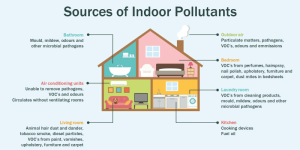
The real danger of the Stack Effect isn’t just the movement of air; it’s what that air is carrying. Since 50% of the air you breathe on the first floor originally came from the basement or crawlspace, the health of your lowest level dictates the health of your entire living environment. This upward draft brings several “invisible passengers” into your bedrooms:
- Mold Spores: Basements and crawlspaces are naturally damp. When moisture meets organic material like wood or drywall, mold flourishes. The Stack Effect then lofts these microscopic spores into your breathing zone upstairs.
- Radon Gas: Radon is a colorless, odorless soil gas that enters through foundation cracks. Because the Stack Effect creates a vacuum in the basement, it actually pulls radon out of the soil and into your home more aggressively.
- Volatile Organic Compounds (VOCs): Many homeowners store paints, cleaning chemicals, and fuels in the basement. The Stack Effect ensures these chemical fumes don’t stay in storage; they migrate upward.
Why “Air-Tight” Modern Homes Face Higher Risks
It is a common misconception that newer, energy-efficient homes are immune to air quality issues. In reality, modern homes are often built so “tightly” to save on heating and cooling costs that they trap pollutants inside. In an older, drafty home, the Stack Effect might move air through, but that air eventually escapes. In a modern air-tight home, the pollutants pulled up from the basement have nowhere to go.
Without mechanical ventilation, these toxins reach a high concentration, leading to what experts call “Sick Building Syndrome.” Homeowners may experience unexplained headaches, increased allergy symptoms, or asthma flare-ups simply because the home’s “lungs” are recirculating contaminated basement air without any fresh air exchange.
Breaking the Upward Flow with Mechanical Exhaust
You cannot stop the laws of physics, but you can manage them. The most effective way to combat the Stack Effect is to break the cycle of upward air migration using a mechanical exhaust system like EZ Breathe. Instead of allowing the basement to act as a reservoir for stagnant air that eventually moves upstairs, a dedicated ventilation system creates a controlled “exit point” at the lowest level.
By actively exhausting the heavy, damp air from the basement directly to the outside, you reverse the negative pressure. Instead of the basement air being pushed up into your living room, fresh, conditioned air from the upper floors is drawn down. This creates a healthy air exchange that flushes out the toxins before they ever have the chance to reach your bedroom.
Frequently Asked Questions
How does the stack effect impact my energy bill?
The Stack Effect forces your HVAC system to work harder. As warm air escapes the top and cold, damp air is pulled in at the bottom, your furnace or air conditioner must constantly cycle to compensate for the unconditioned air entering the home.
Can I stop the stack effect by sealing basement cracks?
While sealing cracks (air sealing) is a good practice, it rarely stops the Stack Effect entirely. Physics will always find a way to move air. The only way to ensure the air you breathe is healthy is to implement a mechanical ventilation strategy that manages the air exchange rate.
Does air quality improve immediately after installation?
Most homeowners notice a change in “air feel” and the disappearance of musty odors within 24 to 48 hours. By removing the damp air that fuels the Stack Effect, the humidity levels stabilize and the concentration of airborne pollutants drops significantly.