

Every year, as seasonal weather transitions occur and outdoor humidity surges, millions of homeowners face the same unwelcome greeting when they open their basement door: a thick, heavy, musty odor. It is a scent that clings stubbornly to stored holiday decorations, ruins upholstery, and effectively makes an entire level of a property feel unlivable.
Many accept this “old basement smell” as an unavoidable tax on having a below-grade space. However, in the world of building science, a persistent odor is a glaring warning sign that your home’s environmental balance is compromised. To reclaim your home’s square footage and protect your indoor air quality, you must understand what causes this distinct scent and how to alter the environmental dynamics of your lower levels permanently.
The Anatomy of the “Old Basement Scent”
To eliminate a musty basement smell, you must first demystify it. The odor is not a natural property of subterranean concrete; it is a direct gaseous byproduct of active microbial growth. When indoor relative humidity climbs and air remains stagnant, microscopic organisms find an ideal habitat to multiply.
Mold and Mildew Colonization
Mold spores exist naturally everywhere in the atmosphere, but they require moisture to settle, activate, and grow. Dark, unconditioned basement environments provide the perfect backdrop. As these hidden fungi feed on organic materials—such as cardboard storage boxes, drywall paper, carpet padding, or wooden subfloors—they release Microbial Volatile Organic Compounds (MVOCs) into the air. That chemical off-gassing is the literal source of the damp, musty smell you are breathing.
Efflorescence and Foundation Block Vapor
Even if you cannot see dark mold patches on your walls, moisture is likely traveling through your foundation. Concrete is highly porous, behaving much like a hard structural sponge. When rain or groundwater saturates the soil outside your home, it migrates through the foundation blocks via capillary action. As this liquid water reaches the interior surface and evaporates into the basement air, it leaves behind a white, chalky, powdery mineral deposit known as efflorescence. This continuous vapor transmission drives up the room’s baseline humidity, refueling the odor cycle day after day.
Why Masking Agents and Traditional Cleaning Fail
When faced with a smelly basement, the standard homeowner response is tactical: lighting scented candles, plugging in air fresheners, or scrubbing down the concrete walls with a bleach solution. While these efforts might yield a brief 48-hour reprieve, they fail to fix the underlying structural problem.
Air fresheners and odor-neutralizing sprays merely introduce heavy synthetic perfumes to temporarily mask the MVOC molecules; they do not remove the airborne toxins. Furthermore, while scrubbing with bleach kills surface mold, it cannot penetrate deep into the pores of concrete or masonry walls, nor can it stop new moisture from seeping through from the outside. If you do not fundamentally change the atmospheric conditions of the room, the musty scent will return every single time.
The Permanent Cure: Professional Mechanical Air Exchange
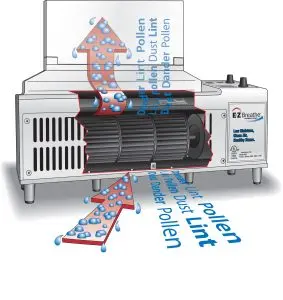
To stop musty basement odors for good, you must move away from temporary band-aids and address the structural physics of your home. This means transitioning from stale, stagnant air to active mechanical air exchange.
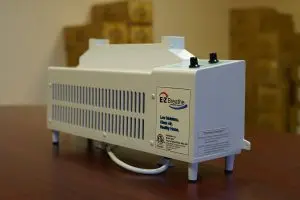
Standard consumer dehumidifiers fall short because they simply cool and recirculate the exact same air volume over and over within the room, all while driving up your monthly utility bills. A dedicated mechanical air exchange system—like the EZ Breathe system—approaches the issue from a structural perspective.
Instead of sitting in a corner recycling stale air, the unit is strategically installed at floor level to target the lowest 18 inches of the basement. This is the exact zone where cold, dense, moisture-laden air, heavy chemical vapors, and soil gases naturally settle. By continuously drawing this contaminated air out of the basement and exhausting it entirely outside the house, the system breaks the humidity cycle.
This active exhaust creates a gentle, continuous pressure shift that coaxes clean, dry air down from the upper, air-conditioned levels of your home. This continuous turnover drops the basement’s relative humidity safely below 50%, effectively forcing mold and mildew into dormancy and stopping the production of musty MVOCs permanently.
FAQs About Managing Basement Odors
Q: Why does my basement smell significantly worse during the summer?
A: Summer months bring peak ambient outdoor humidity and higher dew points. When this warm, moisture-heavy air enters your basement through windows, doors, or structural gaps, it hits the cool concrete foundation walls. This rapid temperature drop causes immediate condensation, creating a perfect accelerator for musty microbial growth.
Q: Can a musty basement smell affect the air quality upstairs?
A: Absolutely. Due to a physical principle called the “stack effect,” warm air naturally rises and escapes through the upper levels of your home, creating a vacuum below. This vacuum draws up to 50% of your first-floor breathing air directly up from your basement or crawlspace, bringing musty odors, mold spores, and dampness along with it.
Q: How long does it take for a mechanical air exchange system to eliminate basement odors?
A: Because a dedicated mechanical air exchange system actively vents the lowest, heaviest layers of air outside, homeowners typically notice a dramatic reduction in stagnant odors and a drop in baseline humidity within the first 48 to 72 hours of continuous operation.
Suggested Next Steps
Living with a damp, musty basement doesn’t have to be an accepted reality of homeownership. If standard cleaning and portable appliances have failed to clear the air under your feet, it is time to look at a whole-home structural solution. Regularly monitor your basement’s relative humidity levels and inspect your foundation walls for signs of efflorescence. To discover how a permanent, low-wattage mechanical ventilation system can reclaim your home’s lower level, contact a local indoor air quality specialist today to schedule a comprehensive air volume evaluation.