

When you walk down into a damp, musty basement, your first instinct is often a trip to the local home improvement store to pick up a portable dehumidifier. It feels like a quick, relatively inexpensive victory. You plug it in, hear the compressor kick on, and watch the water tank fill up. But what feels like a one-time fix actually initiates a cycle of ongoing operational expenses, hidden maintenance fees, and frequent equipment replacements.
Traditional dehumidifiers are fundamentally tactical tools fighting a losing battle against physics. They treat the symptoms of poor indoor air quality without addressing the foundational issue: stagnant air and soil moisture infiltration. In contrast, an advanced air exchange system offers a structural solution that protects your home while costing significantly less over time.
The Energy Drain: Comparing the True Monthly Math
The most immediate hidden cost of a basement dehumidifier shows up on your monthly electric bill. Most standard basement or crawl space dehumidifiers rely on energy-intensive compressors to cool metal coils and condense moisture out of the air. These units typically pull between 500 and 700 watts of continuous power to keep up with subterranean moisture levels.
With the average U.S. residential electricity rate hovering around 17.65 cents per kilowatt-hour (kWh), running a standard 600-watt dehumidifier for just 12 hours a day adds roughly $38 to your monthly utility bill. If your basement is exceptionally damp and the unit runs constantly to maintain equilibrium, that cost easily soars past $75 a month—amounting to over $900 a year just in electricity to run a single appliance.
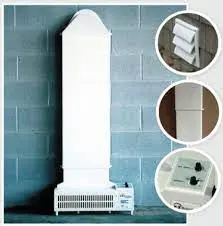
An air exchange system operates on a completely different mechanical principle. Instead of using a high-wattage compressor to squeeze water out of stagnant air, it utilizes ultra-efficient, whisper-quiet fans to expel damp, heavy air directly outside. It pulls a mere 31 watts of electricity—roughly the equivalent of a standard LED lightbulb. Operating continuously, an air exchange system costs only $2 to $4 per month to run, saving homeowners hundreds of dollars annually on utilities alone.
Maintenance, Filters, and the Lifespan Penalty
The initial retail purchase price of a dehumidifier is simply the down payment on its life cycle. To keep these compressor-driven units running, homeowners face constant physical and financial maintenance overhead. Standard units require manual bucket emptying; if forgotten, the unit automatically shuts off, causing moisture and relative humidity levels to spike instantly. Even units modified with gravity drainage hoses remain prone to clogged lines and internal biofilm (bacterial slime) buildup.
Did You Know? The high-stress, high-humidity environments of basements cause consumer-grade dehumidifier compressors to degrade rapidly, typically requiring a complete unit replacement every two to three years.
Furthermore, many modern high-capacity dehumidifiers rely on specialized filters to protect their internal coils from basement dust and debris. Replacing these clogged filters can cost between $30 and $70 annually. Mechanical air exchange systems feature a maintenance-free design with zero filters to replace. Because they focus on air movement rather than refrigeration and condensation, they do not suffer from frozen coils or compressor burnout, resulting in a dramatically longer equipment lifespan that routinely spans decades.
Coverage Scope and Reversing the “Stack Effect”
The stack effect (the physical process where warm air rises and escapes through upper levels of a home, creating a lower-level vacuum that draws in cold, subterranean air from below) occurs constantly in residential structures. Traditional dehumidifiers pull moisture out of the air, but the resulting pressure drop simply draws more damp, radon-tinged air through your foundation walls and floor cracks.
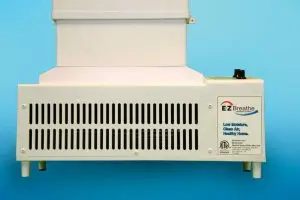
A whole-home air exchange system tackles this head-on by reversing the dynamic. Installed at the lowest point of the home, it continuously expels the cold, dense, moisture-laden air from the floor level. This creates a gentle, continuous pressure shift that draws clean, dry air down from the upper levels, conditioning the entire structure. A single air exchange unit can effectively cover up to 7,000 square feet, providing comprehensive indoor air quality management that no portable box can match.
Long-Term Value Comparison
| Cost & Performance Factors | Standard Compressor Dehumidifier | EZ Breathe Air Exchange System |
|---|---|---|
| Power Consumption | 500 to 700 Watts | 31 Watts |
| Monthly Operational Cost | $30 to $75+ per month | $2 to $4 per month |
| Filter Costs & Maintenance | $30 to $70 annually; frequent cleaning | $0; entirely maintenance-free |
| Typical Equipment Lifespan | 2 to 3 years | 10+ years |
| Effective Coverage Area | Localized (Single room or radius) | Up to 7,000 sq. ft. (Whole-home) |
A Smarter Home Investment
Choosing how to manage your home’s below-grade humidity comes down to a choice between a recurring monthly expense and a permanent property improvement. While a portable dehumidifier has a lower initial retail price, its high energy consumption, hidden maintenance overhead, and short lifespan make it an expensive long-term liability. By investing in a mechanical air exchange system, you address the root cause of moisture, protect your entire home’s structural integrity, and enjoy a maintenance-free solution that pays for itself over time.