

For many homeowners, the attached garage is the ultimate convenience. However, that shared wall between your vehicles and your living space represents a major structural vulnerability for your family’s health.
The Attached Garage: A Reservoir for Volatile Chemical Hazards
We rarely think of our garages as chemical storage facilities, but that is exactly how they function. Every time you pull a car, SUV, or motorcycle into the garage after a commute, the engine doesn’t just cool down silently—it actively off-gasses. As hot internal components settle, they release residual combustion byproducts, including benzene, formaldehyde, and various unburned hydrocarbons, into the enclosed air mass.
Compounding this daily vehicle emission loop are the household toxins we deliberately store in the garage. Shelves filled with half-used paint cans, industrial solvents, chemical fertilizers, pesticides, winterized lawn care equipment containing raw gasoline, and spare propane tanks constantly leak microscopic chemical particles. Collectively, these airborne hazards are known as Volatile Organic Compounds (VOCs), and they transform an unventilated attached garage into a dense reservoir of toxic air.
Mechanics of Contamination: How Fumes Breach the Firewall
Many homeowners believe they are perfectly safe because a thick sheet of fire-rated drywall and a solid-core door separate the garage from the kitchen or mudroom. Unfortunately, standard building codes are designed to slow down physical fire, not to stop microscopic gas molecules from traveling. Gas moves from areas of high pressure to areas of low pressure, and your home is naturally engineered to draw garage air inside through a physical phenomenon known as the Stack Effect.
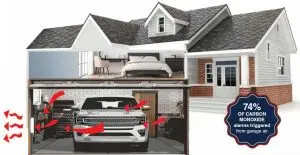
The stack effect occurs because warm air naturally rises and escapes through your upper-level windows, ceiling light fixtures, and attic vents. As this air leaves the top of your house, it creates a powerful vacuum at the bottom of the structure. To balance this pressure drop, your home pulls air inward from the lowest and most adjacent zones available.
As a result, toxic garage fumes are pulled straight through the shared wall. They breach the living space through tiny unsealed micro-gaps in the drywall, plumbing pipe penetrations under sinks, electrical outlet boxes, pet doors, and the friction seals around the main entryway door framing. Studies show that up to 15% of the air breathed on the main floor of a home with an attached garage originally migrated from the garage space.
Health Symptoms Associated with Airborne VOC Exposure At Home
Because chemical air migration happens silently and invisibly, homeowners often fail to connect their household health complaints to the garage. However, chronic exposure to low levels of VOCs and carbon monoxide produces distinct, compounding medical symptoms.
Short-term exposure typically manifests as chronic, unexplained headaches, frequent dizziness, morning sinus congestion, and eye, nose, or throat irritation that mysteriously improves when you leave the house for work or vacation. Over the long term, continuous inhalation of vehicle off-gassing and stored chemical solvents strains the nervous and respiratory systems, worsening asthma symptoms in children and increasing risks for serious chronic conditions.
Why a Basic Utility Fan Isn’t Enough to Secure Your Home’s Air
When homeowners realize their garage air smells toxic, they often install a basic retail utility fan or rely on opening a side window. While passive cross-ventilation helps temporarily when the garage door is wide open, it fails completely when the space is locked up at night or during extreme seasonal weather.
To permanently protect your living spaces, you must use active mechanics to rewrite the air pressure balance of the garage. This requires a dedicated mechanical exhaust system designed to run continuously on low wattage.
Instead of merely spinning the air around inside the room, these systems pull heavy chemical vapors and vehicle emissions directly from the floor level—where dense toxins naturally settle—and exhaust them completely outside the building envelope. By continuously pushing air out, the system creates a controlled zone of negative air pressure inside the garage. Because the garage is now at a lower pressure than your kitchen or living room, the direction of air migration is permanently reversed. Air will naturally leak out of your clean house and into the garage, ensuring toxic fumes can never cross the threshold into your home.
Frequently Asked Questions About Garage Air Migration

Does a standard weather-stripped door completely stop garage air from coming inside?
No. While high-quality weather-stripping is excellent for stopping major drafts, it cannot stop molecular gas transmission driven by pressure imbalances. Because the stack effect creates a natural vacuum inside your living spaces, chemical fumes will easily bypass the door seals via nearby wall cavities, electrical outlets, and structural framing gaps. How long do car exhaust fumes linger in an attached garage after parking?
Harmful volatile organic compounds (VOCs), benzene, and carbon monoxide can remain trapped in an unventilated garage air mass for several hours after a vehicle’s engine is turned off, providing a continuous window of time for those toxins to slowly seep into your house. What is a negative pressure garage ventilation system?
It is a dedicated mechanical exhaust system that runs continuously on a very small amount of electricity (roughly equivalent to a single lightbulb). It expels contaminated air directly outdoors, keeping the garage at a lower air pressure than the main house so that indoor air leaks always flow into the garage, never into the living spaces.
Secure the Air Your Family Breathes
Don’t let invisible vehicle emissions and toxic chemical storage compromise your home’s indoor air quality. Contact our environmental air specialists today to learn more about our dedicated mechanical garage exhaust systems and create a permanent pressure barrier for your home.