

Managing below-grade moisture is a constant financial battle for Ohio homeowners. When your basement or crawlspace starts feeling damp, choosing the wrong appliance can cost you thousands in unnecessary utility bills and equipment replacements.
Ohio’s Climate Profile: Why Below-Grade Moisture Drives Up Utility Bills
Ohio’s distinct geography subjects residential properties to aggressive environmental stress. The state experiences high seasonal humidity, heavy spring snowmelts, and volatile winter freeze-thaw cycles. This constant shift in the local water table forces moisture into the soil surrounding your home, creating continuous hydrostatic pressure against your foundation walls.
Because the vast majority of Ohio’s housing stock features older masonry, porous brick, or concrete block foundations, ground moisture travels easily through these subterranean walls. When this vapor enters the home, it has nowhere to go. Without active air turnover, the relative humidity spikes. Homeowners are forced to run electrical appliances around the clock to prevent mold, protect structural wood, and keep their living spaces habitable. However, the exact technology you choose to control this moisture dictates your monthly overhead.
Initial Purchase Price vs. Lifetime Operating Costs
When a basement begins to smell musty, the immediate reaction for many property owners is to buy a couple of high-capacity portable dehumidifiers from a local big-box retailer. On the surface, this feels like the most budget-friendly choice. A retail dehumidifier costs between $250 and $500 upfront. In contrast, an architectural-grade mechanical air-exchange ventilation system requires a larger initial investment for the specialized hardware and dedicated professional installation.
However, focusing exclusively on the initial purchase price is a major financial oversight. The real cost of moisture management lies in its lifetime operational overhead. Since 2020, residential electricity rates have risen by more than 30 percent on average across the country, heavily impacting household utility budgets (McKernan, n.d.). In Ohio’s competitive energy market, running a standard, high-amperage portable dehumidifier is an incredibly expensive proposition.
Standard home dehumidifiers utilize a heavy compressor and cooling loop that continuously draws between 400 and 700 watts of power. Running this system around the clock to combat Ohio’s humid summer months easily adds $30 to $50+ per month to your electric bill for a single unit. If your layout requires two units, your operational costs compound dramatically.
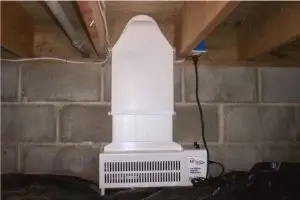
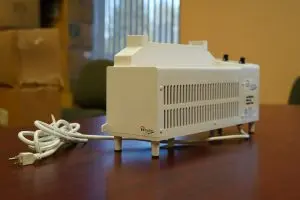
Conversely, a dedicated mechanical air-exchange system does not rely on an energy-hungry refrigeration compressor. Instead, it utilizes precision-engineered, low-wattage fans to actively exhaust the heavy, damp air from the floor level directly outside, creating a pressure pull that draws dry air down from the upper floors. These systems operate continuously on roughly 40 to 46 watts of power—no more than a standard LED lightbulb. This keeps your monthly operational baseline between $2 and $4 per month, instantly returning your upfront investment through lower utility bills.
The Maintenance Tax: Factor in Your Time and Replacement Parts
Beyond electrical consumption, homeowners must account for the ongoing “maintenance tax” associated with portable dehumidification units. Portables are highly prone to mechanical breakdown, often failing within two to four years of continuous below-grade use. They also demand constant human intervention.
If you do not have a dedicated floor drain, you must manually empty heavy water trays daily. When a tray fills up while you are away, the unit automatically shuts off, allowing moisture levels to surge right back up. Furthermore, retail dehumidifiers feature plastic mesh filters that require regular washing, and the stagnant water in their drain pans frequently develops a thick, slimy biological film that requires manual bleaching.
An active mechanical ventilation system eliminates this labor entirely. Because the moisture is exhausted directly outdoors as a gas rather than condensed into liquid water, there are no reservoirs to monitor, no buckets to dump, and no dirty water lines to flush. The system runs 100% maintenance-free, saving you hours of labor and eliminating the recurring cost of replacement parts.
Structural ROI: How Proper Air Turnover Safeguards Ohio Property Values
Investing in a continuous mechanical air-exchange system also acts as an asset-preservation strategy. True air-exchange units don’t just extract moisture; they actively exhaust airborne toxins, odors, and soil-based hazards like radon, which is highly prevalent across Ohio.
By dropping the moisture baseline and replacing stagnant air volumes multiple times a day, mechanical ventilation prevents mold spores from colonizing your floor joists and drywall. When the time comes to sell your home, you avoid the devastating financial blow of a failed real estate mold inspection, which can stall home sales and require thousands of dollars in emergency structural remediation. Additionally, by lowering the total relative humidity of the house, you reduce the heavy thermodynamic load on your main HVAC infrastructure, extending the working lifespan of your primary furnace and air conditioner.
Frequently Asked Questions About Ohio Home Ventilation Costs
How much electricity does an active mechanical ventilation system use compared to a basement dehumidifier?
An active mechanical air-exchange system operates on an ultra-low power footprint of approximately 40 to 46 watts, costing roughly $2 to $4 per month to run continuously. A standard retail basement dehumidifier draws between 400 and 700 watts of power, adding $20 to $50+ per month to your local utility bill, depending on your exact regional electricity rate. Are there local indoor air quality standards or building regulations in Ohio regarding ventilation?
Yes. Modern Ohio residential building codes emphasize mechanical ventilation requirements for newer or extensively renovated properties. Because modern home construction techniques focus heavily on tight, well-insulated home envelopes, they inadvertently trap indoor allergens, stale odors, moisture, and dangerous ground gases like radon. Active ventilation ensures compliance with healthy home standards. Can I install a whole-home mechanical ventilation system myself to save on costs?
While some basic components can be purchased directly, professional installation through a factory-trained regional specialist is highly recommended. Certified installers understand how to accurately calculate the unique pressure balances of your specific floor plan, safely core through foundation headers without compromising structural integrity, and ensure your long-term equipment warranty remains fully intact.
Stop Wasting Money on Energy-Guzzling Band-Aids
Protect your home, your family’s health, and your monthly budget from rising utility costs. Contact our Ohio indoor air quality specialists today to schedule an evaluation and discover how a maintenance-free mechanical ventilation system can permanently dry out your property.